GPS Options for Local Trucking Fleets

Posted by | Posted in Equipment Issues, Industry Trends, News and Links, Technology for Local Trucking | Posted on 11-11-2011

We found this article on TruckingInfo.com that discusses the possible options and benefits of deploying GPS in a smaller fleet:

Click here to see the full article.

Depending on what works best with your TMS, there are a variety of GPS packages that can give you the functionality you need.  In addition to watching GPS “breadcrumbs” on a screen, dispatchers can benefit from systems such as Actsoft’s Comet Tracker, which has simple drop-down forms for drivers to enter arrival and departure times; this can be used as an alternative to geofencing.

Keep in mind that EOBR rules that usually apply for OTR fleets are waived for local trucking because of the 100-mile exemption.

–The Editors


Read More

Credit Application for Local Trucking

Posted by | Posted in Costs and Cash Flow in Local Trucking, Legal / Lawyers / Attorneys | Posted on 20-09-2011

Getting a signed credit application from every customer is one of the most important actions a local trucking company can do to protect itself.  What is most important is NOT the bank information, or the references.  The important part is the fine print.

Somewhere in every credit app there should be statements that:

  • The customer agrees to pay invoices within XX days
  • If not paid on time, the interest rate is XX%
  • Customer pays collection costs

If your credit app does not contain this verbiage, find one that does and copy the key sentences.

The reason this is so important is that, without this language, a court may rule that the customer never promised to pay and therefore does not have to!  Without a formal contract, the credit app is the only document wherein the customer promises to pay you.  This is very important if any collection effort is needed in the future.  If there is not a provision for interest, the court will not grant any interest!  Finally, it is very expensive to take a customer to court–and unless the customer has agreed in advance to pay for this expense, the court WILL NOT award collection expenses!

You never want a prospective customer to think about these issues, so present the document in a non-threatening way.  Say “I know you have not decided to use us, but I want to set up an account just to be ready.”  If they do not want to give a bank reference, or even customer references, NO PROBLEM!  The most important thing is the signature anyway.  We recommend wording, in big bold letters, that signing the credit app DOES NOT obligate the prospective customer to ever use the local trucking services.  Point to it when asking for them to fill out and sign the credit app.

Your local trucking business will benefit from following the simple steps above for a credit application with teeth.

Read More

California Supreme Court Decision in Trucking Company Employer-Liability Case

Posted by | Posted in Legal / Lawyers / Attorneys, News and Links | Posted on 03-08-2011

We thought this was worth your consideration:

California Supreme Court Decision

Check it out.

–The Editors


Read More

HHUT: When To File, When To Pay in Local Trucking?

Posted by | Posted in Costs and Cash Flow in Local Trucking, Legislative Issues, News and Links | Posted on 01-08-2011

The Internal Revenue Service today advised truckers and other owners of heavy highway vehicles that their next federal highway use tax return, usually due Aug. 31, will instead be due on Nov. 30, 2011.

Because the highway use tax is currently scheduled to expire on Sept. 30, 2011, this extension is designed to alleviate any confusion and possible multiple filings that could result if Congress reinstates or modifies the tax after that date. Under temporary and proposed regulations filed today in the Federal Register, the Nov. 30 filing deadline for Form 2290, Heavy Highway Vehicle Use Tax Return, for the tax period that begins on July 1, 2011, applies to vehicles used during July, as well as those first used during August or September. Returns should not be filed and payments should not be made prior to Nov. 1.

To aid truckers applying for state vehicle registration on or before Nov. 30, the new regulations require states to accept as proof of payment the stamped Schedule 1 of the Form 2290 issued by the IRS for the prior tax year, ending on June 30, 2011. Under federal law, state governments are required to receive proof of payment of the federal highway use tax as a condition of vehicle registration. Normally, after a taxpayer files the return and pays the tax, the Schedule 1 is stamped by the IRS and returned to filers for this purpose. A state normally may accept a prior year’s stamped Schedule 1 as a substitute proof of payment only through Sept. 30.

For those acquiring and registering a new or used vehicle during the July-to-November period, the new regulations require a state to register the vehicle, without proof that the highway use tax was paid, if the person registering the vehicle presents a copy of the bill of sale or similar document showing that the owner purchased the vehicle within the previous 150 days.

In general, the highway use tax applies to trucks, truck tractors and buses with a gross taxable weight of 55,000 pounds or more. Ordinarily, vans, pick-ups and panel trucks are not taxable because they fall below the 55,000-pound threshold.

For trucks and other taxable vehicles in use during July, the Form 2290 and payment are, under normal circumstances, due on Aug. 31. The tax of up to $550 per vehicle is based on weight, and a variety of special rules apply to vehicles with minimal road use, logging or agricultural vehicles, vehicles transferred during the year and those first used on the road after July.

Read More

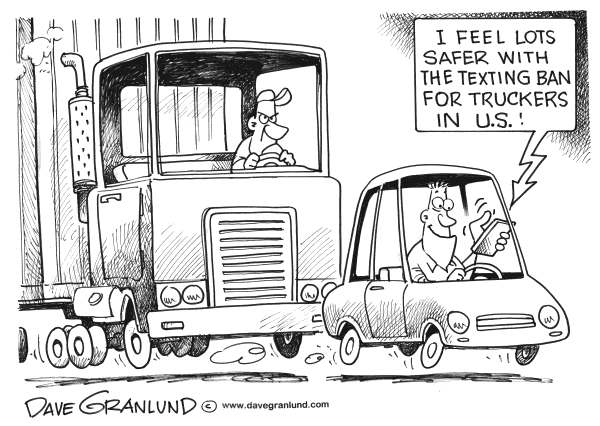
Texting (or Not) While Driving — the Local Trucking Angle

Posted by | Posted in Industry Trends, Legal / Lawyers / Attorneys, Legislative Issues, News and Links | Posted on 28-07-2011

As of this writing, 34 states, the District of Columbia, and Guam have adopted laws prohibiting texting while driving. These laws cover all drivers, not just truck drivers.

Click here to see a table of all current state texting laws.

Illinois, Texas, and Arkansas also ban any use of cell phones in school and construction zones.

safe local trucking driving

Don't Text and Drive Your Truck!

Also, for just over a calendar quarter now, no truck driver in the nation may text while transporting hazmat.  Click here to read more.

What is your experience with local trucking and the new texting laws?

–The Editors

Read More

Indemnification Clause in Local Trucking Contracts

Posted by | Posted in Industry Trends, Legal / Lawyers / Attorneys, News and Links | Posted on 20-06-2011

Many local trucking companies have been confronted with contracts containing an Indemnity clause.  It typically states:

“CARRIER shall at all times indemnify, defend and hold harmless BROKER, its parent, subsidiaries and affiliates, and their respective directors, officers agents and employees against and from any and all claims arising from the services provided hereunder (including, without limitation, claims for personal injury, death and damage to property, clean‑up costs from commodity spills and damage to the environment, whether or not caused by (a) by any agent or employee of CARRIER or (b) by any other person or entity.  The provisions of this Paragraph shall survive cancellation, termination, or expiration of this Agreement.”

This means that even if an accident is caused by the broker’s negligence, or shipper’s negligence, or by any reason whatsoever, the carrier is responsible to pay legal fees, claims, and judgments against the broker. Of course, this is very unfair.  The problem has been that carriers are rarely given a choice.  The attitude is typically, “sign this or forget about getting work,” and, because of business pressures, many sign.  Some insurance policies would not pay such a claim, so the carrier is risking its very existence by signing such a document.

Well, help is at hand in most of the USA.  During the past two years, most states have passed, or are considering passing, an “anti-indemnification” law.  The law invalidates any clause that forces the carrier to indemnify the broker.  If you live in a state that has passed “anti-indemnity” laws, you can safely sign contracts that contain the clause and know it cannot be enforced.

WARNING! If the contract states that it shall “be construed under the laws of …….”, with a different state filled in, make sure THAT state is one that has passed an “anti-indemnity” statute or you WILL NOT be protected.

To see a map of states which have passed “anti-indemnity” statutes, click here.


Read More

Hiring Qualified Local Truck Drivers

Posted by | Posted in Personnel and HR Issues | Posted on 14-06-2011

We here at the Local Trucking Blog have been hearing about increasing difficulty hiring qualified, experienced local CDL drivers.  Everyone agrees the CSA initiative (click here to see more) helps in weeding out unsafe candidates, but that is only part of the equation.  Certain skills are much more important to a local operation.

It is no big deal if a truck takes 15 minutes to spot a trailer after traveling five days cross country.  It is a very different story when you expect productivity of 20 stops a day.  This is why your test drive should include plenty of backing and spotting exercises.

Do you carry hazardous materials? Don’t count on the Hazmat license endorsement to tell you anything about what the candidate knows.  You should have a written test.

Same for other important skills, such as routing and emergency procedures.  A few math questions will help determine if they can accurately count a multi-pallet shipment.

Liftgates? Make them take a skid up and down.

E–track or logistics in your trucks?  Make them secure some freight.

Expect at least 50%, and possibly 80% of your driver candidates to flunk the test.  This is good.  It is always worth waiting for the best driver to hire instead of panicking and taking the best available candidate on hand at the moment.  Your company will be rewarded with lower turnover, lower claims, and higher productivity.

Read More

Keeping Your Docks Safe in Local Trucking

Posted by | Posted in Equipment Issues, News and Links | Posted on 10-05-2011

We came across an interesting approach for keeping trucks connected to docks and preventing injuries.

Click here to read the complete article.

While it’s written by a biased source (the author works for a company that makes RIG-based and wheel restraints), the issues are worth exploring, and you can’t argue with improving safety and reducing injuries.

Who out there has experience with restraints of these types?


Read More

A Mileage Tax On Local Trucking?

Posted by | Posted in Industry Trends, Legislative Issues, News and Links | Posted on 06-05-2011

A proposal is being floated in Washington that would tax mileage on all vehicles–including local trucks, OTR trucks, even cars.

http://www.truckinsurancepro.com/industry-news/proposal-to-tax-mileage/

Take a look, read all about it, and contact your legislators if you are so moved.

Keep rolling,

Jonathan Miller, Editor


Read More

How to Cope with $5.00 Diesel in Local Trucking

Posted by | Posted in Costs and Cash Flow in Local Trucking, Equipment Issues, Industry Trends, News and Links | Posted on 27-04-2011

It now costs over $200 to fill up a straight truck, and pouring 120 gallons into your twin-75 equipped tractor can cost $500.  In an earlier post we discussed fueling strategies.  If $10 is saved on labor, it is as good as $10 saved on fuel cost.  What else is there?

We are not going to list all the well known strategies for reducing fuel efficiency, such as more efficient trucks, driving slower, less idling, correct tire pressure, etc.  Many of these techniques have little benefit in the local trucking universe.  Often overlooked is what kind of diesel is being used. This is a potential money-saver for you.  Think about it.

During the winter months diesel is often blended with expensive additives to prevent ice buildup.  Sometimes standard practice starts the “additive season” too soon and ends too late.  The difference in cost can be ten cents per gallon or more.

In the warmer months, or warmer climates, biodiesel is an excellent choice.  Because of government subsidies, biodiesel is often $0.15/gallon less than plain diesel.  Biodiesel gets the same or better mileage and comes with no additional maintenance or other expense.  Look for a source, figure out the extra labor cost (if any) to get the truck to the appropriate facility, and make an informed decision.  Most wet fueling operations can provide biodiesel.  It is your tax dollars that are providing the subsidy, so you might as well get some benefit from it.

So, what is biodiesel?  Biodiesel is a blend of diesel fuel with organic materials other than ethanol, such as used cooking grease, canola oil, etc.  It is refined and cleaned before use.  Here is a link to an interesting slide show about biodiesel:

http://www.biodiesel.org/resources/sustainability/pdfs/Advance_Biofuel_Webinar_20100827.pdf

As usual:  keep doing the homework, and you can probably keep finding new places to save money.

Read More