When you run a local trucking company, it’s frustrating enough when one of your employees gets injured on the job. What makes it worse is that you also often face medical bills and higher insurance premiums. Does this sound like you?
Here at the Local Trucking Blog, we’ve learned how to keep a lid on medical expenses and worker’s comp premiums. By paying certain claims in-house, without sending them to WC insurance, you can save thousands of dollars a year.
Paying the costs of an employee’s injury in-house, without making a WC claim, allows you to reap the following benefits:
- avoid adding the claim to your WC insurance loss record;
- keep the claim off your “experience mod” and lower your WC renewal premium rates;
- improve your relationships with your employees; and
- keep your employees away from lawyers.
These benefits are only available if you handle it in-house, without a claim, so that decision is the first one to make.
The First Question: To File or Not To File?
If you file a claim with your WC carrier, you should follow it closely with your insurer as it moves through the system; that process is the topic of a future blog post. If you are considering keeping it in-house, you still have more decisions to make:
- Are you willing and able to do the math on what it would cost you to keep the matter in-house? If not, just file the claim.
- Are you willing to go over the top to act aggressively in your employee’s best interest? If not, you shouldn’t handle the injury in-house—just file the claim.
The Second Question: If you keep the costs in-house, how much is this injury likely to cost you?
You may have a threshold dollar amount in your head. Certain injuries, such as a broken ankle, would cost you enough that it’s a no-brainer: if the expenses exceed your threshold, you’ll just file a claim, and so would we. As a broad rule of thumb, most injuries where the employee will miss more than a week of work are things you’d file with insurance. Less severe injuries create a gray area. This gray area represents an opportunity for you.
If you file a claim, your WC insurance company will pay the following:
- Temporary Total Disability (TTD): a percentage (varying by state) of the employee’s wage base for each day missed from work, usually starting with Week 2
- The state-mandated rates for medical bills (more on that below), paid to medical providers; most states have these standard rates, so check with your state’s WC department or website
- You will also have subsequent costs for higher insurance premiums next year—because every claim that goes into your insurance will affect your renewal rates in two ways. (1) Your “experience mod” will increase and will automatically raise premiums. (2) The loss ratio with your insurance company will worsen, triggering the underwriter to also raise premiums. These costs can kill you, because WC insurance in some states is a whopping 18% or more of payroll.
If you take care of this situation in-house, we suggest that you pay the following:
- The employee’s normal pay, to be paid while s/he is off work, starting immediately
- All medical bills (incurred as much as possible at clinics of your choice, where you know the costs in advance—more on that below)
You can do the math. Whatever your choice, keep in mind that if a claim starts to exceed the budget you set, you can still call your insurance company and make a claim. Generally, you will be reimbursed for money that you’ve already put out.
Example: Let’s say that Phil, the general manager at ABC Cartage Company, is considering paying in-house for injuries that aren’t going to cost more than about $5,000. ABC Cartage Company has a driver named Ray, who tripped on a lift gate and has some broken ribs. He may be looking at some time off from work to heal. Let’s say that Ray works 40 hours a week and is loyal and productive, with a great attitude, not adversarial at all. Phil, the GM, has figured Ray’s injuries might cost $5,000 to $7,000 out of pocket. That’s on the high side of Phil’s threshold, but it’s less when compared to what ABC Cartage would have to pay in renewal premiums if something like this goes on ABC’s loss record. In this case, Phil is inclined to avoid filing the WC claim with insurance, preferring to handle it in-house.
The Third Question: Are You Willing to Go The Extra Mile For Your Employees?
You are generally obligated to pay 100% of your employees’ medical expenses whenever they are injured on the job. If you want to handle a payment for an injury in-house instead of submitting the claim to your insurance, then it’s up to you to demonstrate to your employee that you are going to take terrific care of him or her and that you have his/her best interest in mind.
Why do you want to overwhelm your employee with good care and good will? Because you want to keep your employee from going to a lawyer. A worker’s comp lawyer is bad news for many reasons. Your employee’s hiring a lawyer means that your insurance company will also have to have a lawyer. Two opposing lawyers doing anything gets expensive quickly. Your insurance company will pass those costs along to you in all the ways it can. In addition, your employee will probably recover the same amount with a lawyer as without one, and the employee will give up about 20% of that amount in attorneys’ fees.
(Lawyers actually have very little power in WC cases; they can’t change the standard percentages that are paid out, which are fixed by law — e.g., the loss of a finger is paid at “X percent of a man”, TTD is xx% of pay, etc. It’s only in the rare “squishy” areas subject to negotiation that a lawyer has any real value to the employee in a WC case. But once the employee goes down the path of hiring a lawyer, both you and your employee are out a lot of money. )
Let’s get back to our example at ABC Cartage Company. Phil, the GM, reviews the situation and decides that he’s going to handle it in-house. So Phil says to this driver, “Listen, Ray, I’m sorry that you’re hurt. We’re going to take great care of you. We’ll pay you right away—no missed wages—all your normal pay, 40 hours a week—and we’ll take care of all your medical bills. We’d like you to go to a clinic near here. They have great doctors and will take terrific care of you. We want you back at work and ready to rock as soon as possible. ”
If I were Ray, I would be thrilled at the idea of not having to give up that week of pay. I would be happy that my employer is that committed to me and my health. I would want to get back to work right away at ABC Cartage. If Ray lives an hour from your terminal and wants to go to his own doctor, then by all means just say “yes” to that, remembering that you don’t have to pay any health provider more than the established rate, no matter what you are billed—as long as you follow the steps outlined below.
5 Proven Steps to Cutting Your WC Medical Expenses
If you’re ready to take the plunge and handle an employee’s injury costs in-house, congratulations! Here’s the path to success:
1. Find out if your state has a standard “state rate” at which insurance carriers reimburse local clinics for the services they render. Most states have something like this.
2. Take a brief look at bills that you have paid over the past year or two for WC-related medical services for any injured employees. Item by item, compare the prices that your medical providers (or your employees’ providers) have charged with the standard state rate for the same services. For example, let’s say you have a driver who broke an ankle and needed an office visit, X-ray and cast. Look at (a) the gross rate that the drivers’ clinic or hospital charged for the office visit, X-ray and and cast and (b) the rate at which the insurance company reimbursed the clinic or hospital for the same three items.
3. You’ll probably notice a large gap between the clinic/hospital standard billing rate—what we might call “retail”—and what the insurance company actually paid, which is the WC state rate. You don’t ever want to pay more than the state rate when you’re paying the cost yourself. (In general, if you do Step 4 below, you won’t have to.)
4. Lower your direct-pay medical bills by taking the following steps:
- Identify medical clinics close to your terminal that you like, with which you and/or your employees have had a good experience in the past.
- Approach a top-level person at the clinic (like the executive director, head administrator, etc.), and tell him or her that you would like to steer your company’s WC business their way on the condition that they will agree in advance to bill your trucking company at the state rates or lower.
- For specialized services outside the scope of these “house” clinics, you can go one step further. Negotiate in advance a rate for every such service you think you will need. You may very well find a rate below the state rate with a promise of immediate payment. An example is this: call up a local MRI provider in a strip mall near you, and ask, “If my guy brings a check for an MRI, what’s the minimum that I would have to pay for it?” If you have negotiated in advance to pay a local clinic the state rate, you do not need to offer immediate payment.
- Watch how many providers get interested when you say you will pay the same day. Cash is king in medicine, just as it is in your local trucking company!
5. Get everything in writing that you have negotiated with each provider, including a commitment from to adjust its bills downward in advance before sending them to you. They should be glad to do this extra legwork if it means they don’t have to worry about when they’ll get paid.
A Real-Life Example
Below is an example of an adjusted medical bill from a clinic that agreed in advance to lower its rates to the equivalent of state rates in exchange for payment upon delivery of services. This is from a real trucking company that uses the strategies we’ve outlined here. The names of the clinic and patient have been deleted for reasons of confidentiality.
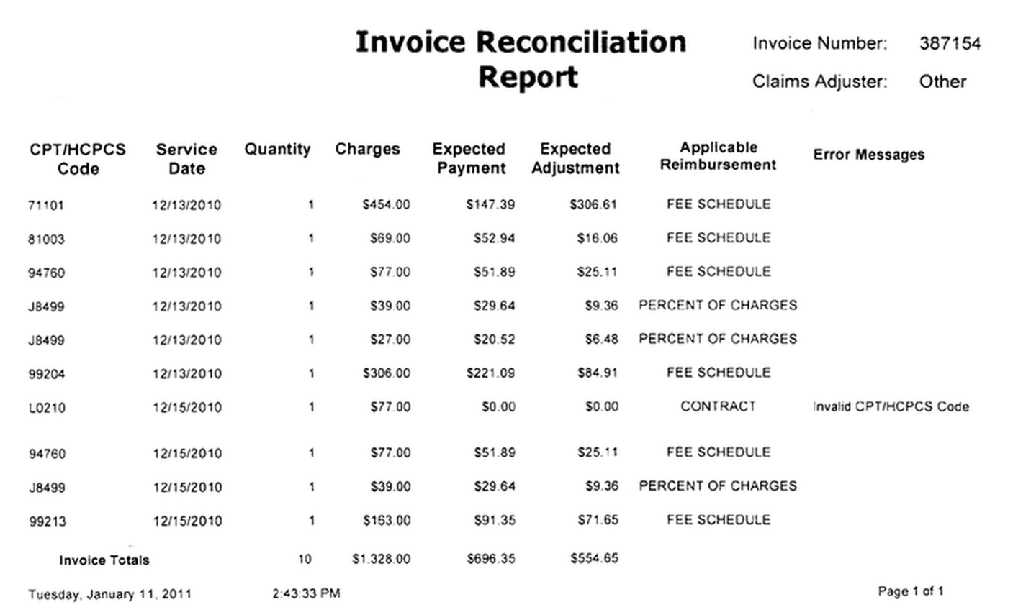
Sample Medical Invoice with Adjustments to State Rates
Look at this. The first item on the invoice is code 71101, an x-ray of chest and ribs. By negotiating a better rate up front, this trucking company got a service that normally costs $454.00 for a mere $147.39 – a reduction of more than 2/3 in the fee! On a total invoice that would have cost $1,328.00 at “retail,” the clever trucking company got a whole array of medical services for $554.65 – a savings of more than 57%. This is a real-life example. Remember that the savings are compounded: not only are you never paying more than the state rate, but none of this is going on your insurance, adding to your loss ratio, raising your experience mod, raising your renewal premiums, and so on. In exchange for a modest direct payout of wages and medical bills, you have avoided a whole slew of insurance costs.
Using this approach can even save you money retroactively. Contact your state WC office and ask how far back in time your state permits you to recover amounts that you were overbilled by providers. The burden is still on you to ask the provider to refund the difference, but every dollar you recover like this is money in your pocket.
Have you tried this in your own company? Have questions? Want to comment? Please do. Leave them in the “comment” section, and we’ll reply.
Disclaimer: The content of LocalTruckingBlog.com is intended for general information purposes only, and is not legal advice. State law varies, and you should consult with an attorney on these matters.
Read More