On-Site or In-House? Hosting Your TMS Data In the Cloud

Posted by | Posted in Costs and Cash Flow in Local Trucking, News and Links, Technology for Local Trucking | Posted on 12-01-2013

A number of TMS providers now offer local trucking companies a variety of alternatives to the traditional in-house installation. In the more traditional setup, both the software application and your TMS data reside on a physical server in your company’s office building. For many local P&D companies, this method of hosting data in-house may still be the best one.

However, there are some other newer options for TMS hosting that you may want to consider.  They include the following:

1.   Data in the Cloud, an App on your Desktop (“Managed Hosting”)

In this scenario, you would launch your TMS by clicking on an icon on your desktop, just as if you’re launching Excel.  The TMS application appears on your screen, just as it would if your data lived on your local. The only difference from the traditional in-house model—a difference that is invisible to the user—is that your data lives offsite, hosted by your TMS provider or one of its trusted providers such as Rackspace.

2.  Data in the Cloud, App in the Cloud (an “All-Cloud TMS)

With this alternative, the TMS application itself lives “in the cloud” and is a web-based application.  You get to it by going to a website and logging in there.  You may already have experienced something like this if you use an offsite login to get access to your Exchange e-mail server.

How to Decide?

As usual, there are advantages and disadvantages to any setup. For example, some add-on TMS options (such as GPS or route optimization) require you to have an in-house TMS, so that its database can talk to your TMS’s database.  In some cases, the cloud-hosted database works just fine with third-party vendors.  Check with your current and potential future vendors and see which is the best option for you.

Happy Shopping from the Local Trucking Blog!

–The Editors

Read More

No Direct Connect? No Problem!

Posted by | Posted in Equipment Issues, Industry Trends, News and Links, Technology for Local Trucking | Posted on 15-10-2012

The best way to manage your communications between dispatchers and drivers is to eliminate the need for so much talking.

OneTerminal TMS from JSY Software is your solution. It virtually eliminates risky talk with drivers.

  • Automatically, and without the need for any driver input at all, keep track of available weight and space capacity on every truck, in real time.
  • Keep track of Hazmat quantities and weights, in real time. Send placarding alerts.
  • Send order details, including routing instructions, with a single mouse click.
  • Best of all: No talking required.

Make your drivers safer and give your staff and customers better information – and get it faster.

OneTerminal TMS gives you a better operation with almost no driver talk.

For your free hands-on consultation, fill out the short form below, or contact us at jmiller @ jsysoftware.com (Jonathan Miller) or 877-540-0030.

[contact-form] [contact-field label=”Name” type=”name” required=”true” /] [contact-field label=”Email” type=”email” required=”true” /] [contact-field label=”Website (optional)” type=”url” /] [contact-field label=”Comment” type=”textarea” required=”true” /] [/contact-form]

Read More

GPS Options for Local Trucking Fleets

Posted by | Posted in Equipment Issues, Industry Trends, News and Links, Technology for Local Trucking | Posted on 11-11-2011

We found this article on TruckingInfo.com that discusses the possible options and benefits of deploying GPS in a smaller fleet:

Click here to see the full article.

Depending on what works best with your TMS, there are a variety of GPS packages that can give you the functionality you need.  In addition to watching GPS “breadcrumbs” on a screen, dispatchers can benefit from systems such as Actsoft’s Comet Tracker, which has simple drop-down forms for drivers to enter arrival and departure times; this can be used as an alternative to geofencing.

Keep in mind that EOBR rules that usually apply for OTR fleets are waived for local trucking because of the 100-mile exemption.

–The Editors


Read More

Collecting Small Trucking Invoices

Posted by | Posted in Legal / Lawyers / Attorneys, Legislative Issues | Posted on 21-09-2011

Local trucking sometimes involves the collection of small invoices.  Sending out bills is good;  but getting a new customer can be nerve-wracking.  Will they be happy with the service?  Will they pay their invoices?  Did they switch because their previous carrier cut them off?  References and credit checks only go so far, and that is not far enough.  Ultimately, it is always a risk to add a customer.  Here are some ways to lessen the risk.

Let’s suppose that your shiny new customer has failed to pay the first few invoices.  What to do now?  Legal action is very expensive, and you can never be sure of the outcome.  Here are a few ideas to try after your in-house efforts to collect are exhausted:

  1. Invoice Other Parties to the Transaction:  There are numerous court cases and their rulings sometimes conflict, but there is enough case law out there to justify your taking this step.  Unless section 7 of the BOL is executed, you can try to collect freight charges from other parties to the shipment.  It may be the shipper, or consignee, or both if arranged by a third party.  Start with an apologetic call in which you inform them that, even though they may have paid for shipping already, they are liable to you for the charges because “……………” (whoever is not paying you) did not pay the freight invoice.  You can tell that other party that you are sorry, of course, to have to take this course of action, but the law is clear, and it was put in place to protect carriers like your company from situations exactly like this.  Gently suggest that they call the offending party and encourage the invoice to get paid, solving the problem.  This puts huge pressure on your customer, as now THEIR customer or vendor is angry with them.  If this initial call does not do the trick, go ahead and issue an invoice, and follow with collection calls to everyone.
  2. Find a Specialized Attorney:  There are attorneys and firms that specialize in small collections and can be effective with claims under $1,000.  Typically they start with a series of letters and then go to lawsuit.  Here is a common arrangement:  You send the attorney copies of unpaid invoices (with supporting documents and any explanations).  The attorney will try to collect and, if successful, will charge you a fee between 20-30% of anything collected.  If this fails, you may be offered the choice to file a lawsuit by paying for court costs (different in every state, often over $100).  After this point the attorney keeps about 50% of anything collected.  The attorney may suggest you accept less than the amount owed, meaning you end up with well under 50% of the original charges.  What you’ll be left with is better than nothing, and in particular, the act of documenting the deadbeat customer will help future carriers make better credit decisions.  Word gets around.  Because some shippers are in the habit of stiffing local trucking companies on a regular basis, your taking strong action in this way will make it less likely that shippers will pick your company as a victim.
  3. Settle:  It is unpleasant, but sometimes the situation calls for a business decision.  Try calling and asking what THEY think is the fair amount to pay–and then, when an amount is mentioned, just accept.  Better to get something rather than nothing. The process of settling is not only much faster but also probably yields the same amount (after fees) as a collection placement.  Make sure you have a system in place that prevents accepting more work from that party in the future.

Read More

How to Cope with $5.00 Diesel in Local Trucking

Posted by | Posted in Costs and Cash Flow in Local Trucking, Equipment Issues, Industry Trends, News and Links | Posted on 27-04-2011

It now costs over $200 to fill up a straight truck, and pouring 120 gallons into your twin-75 equipped tractor can cost $500.  In an earlier post we discussed fueling strategies.  If $10 is saved on labor, it is as good as $10 saved on fuel cost.  What else is there?

We are not going to list all the well known strategies for reducing fuel efficiency, such as more efficient trucks, driving slower, less idling, correct tire pressure, etc.  Many of these techniques have little benefit in the local trucking universe.  Often overlooked is what kind of diesel is being used. This is a potential money-saver for you.  Think about it.

During the winter months diesel is often blended with expensive additives to prevent ice buildup.  Sometimes standard practice starts the “additive season” too soon and ends too late.  The difference in cost can be ten cents per gallon or more.

In the warmer months, or warmer climates, biodiesel is an excellent choice.  Because of government subsidies, biodiesel is often $0.15/gallon less than plain diesel.  Biodiesel gets the same or better mileage and comes with no additional maintenance or other expense.  Look for a source, figure out the extra labor cost (if any) to get the truck to the appropriate facility, and make an informed decision.  Most wet fueling operations can provide biodiesel.  It is your tax dollars that are providing the subsidy, so you might as well get some benefit from it.

So, what is biodiesel?  Biodiesel is a blend of diesel fuel with organic materials other than ethanol, such as used cooking grease, canola oil, etc.  It is refined and cleaned before use.  Here is a link to an interesting slide show about biodiesel:

http://www.biodiesel.org/resources/sustainability/pdfs/Advance_Biofuel_Webinar_20100827.pdf

As usual:  keep doing the homework, and you can probably keep finding new places to save money.

Read More

Local Trucking Company Lends A Hand for Wildlife Documentary

Posted by | Posted in Equipment Issues, News and Links | Posted on 26-04-2011

Moose alert!  Way’s Transport, a local trucking company in Western Newfoundland, Canada, lent its resources recently to National Geographic (NG) for a video shoot.  NG was looking for video footage of moose in the Northern Peninsula, where collisions between trucks and moose are common.

Click here to read the story.

“Moose racks” can help to reduce vehicle damage from such collisions.

Moose accounted for 3,400 vehicle crashes in Maine from 2000 to 2004, according to the Center for Disease Control:  here’s a detailed article.

http://www.cdc.gov/mmwr/preview/mmwrhtml/mm5547a3.htm

In late spring, moose are drawn to roads for the salt left there by vehicles.

–Jonathan Miller, Editor

Read More

How do I get my local trucking company more work from freight brokers?

Posted by | Posted in Industry Trends | Posted on 20-04-2011

More and more shipments, including local delivery, are being controlled by freight brokers or their fancy-named cousins, logistics providers.  There are many considerations for doing business with brokers–but first, you must get the freight offered to you.

How do you successfully solicit shipments from freight brokers?  The first step is to contact a prospective broker.  Most brokers do not have a specific dispatcher assigned to local pickup & delivery.  Each dispatcher generally has a personal local resource list. You can understand a dispatcher sometimes wanting to guard that list against revealing to other dispatchers.  The trick is to gain a beachhead with one dispatcher and then leverage that relationship to get introduced to other dispatchers that may need local services.

Once you have interested a broker in your services, the next step is to fill out an information sheet.  This rarely asks the questions that pertain to local P/U & delivery, such as:  “Do you have straight trucks?” or “Do you have liftgates?”, etc.  Often you are asked to simply list states in which you do business.  It is difficult to define a metropolitan area.  All these questions are barriers to local operations.  The information you provide is usually entered into a spreadsheet format that has no room for “explanations.”  You must consult with your prospect to determine the best way to enter information such that it is visible to other prospective users.

The path is difficult, but the rewards are worth it.  You must “sell” each dispatcher as if s/he were a separate customer.  Keep in mind that dispatchers often change jobs and usually bring their “stable” of customers and resources with them, potentially providing you with fresh dispatchers to solicit.  Resist the urge to get the work thru price reduction.  Brokers use one-truck operators, unregistered carriers, etc. who can all undercut your rate.

Do not try to match rates;  concentrate instead on work that would be profitable for you if you got it.  Accept the fact that 90% of freight is going to the lowest price and you are competing for the remaining 10%, which is often the only work worth doing.

There are many other consideration for doing work with brokers, some of which will be examined in future blog posts.  In the meantime, do not ignore this potential rich source for future business.

Read More

Analyzing Fueling Costs for a Local Trucking Company

Posted by | Posted in Costs and Cash Flow in Local Trucking, Equipment Issues | Posted on 19-04-2011

With fuel costs skyrocketing, and customers resisting additional fuel surcharges, it is all the more important to find areas to save money. Your decisions about how trucks are fueled can have a significant effect on your profitability. There are three choices for local operations:

  1. Fueling off-site
  2. Fueling at on-site facility
  3. Contract for wet fueling

Each method presents positives and negatives, costs and benefits. By analyzing the variables, you can arrive at the best solution for your business. Let’s examine each one in turn.

1. Fueling off-site: This includes fuel card programs, off-site fueling facilities, etc. The direct costs are minimal, just the administrative cost of handling the cards and receipts. You will be paying retail price for the fuel, with some ability to shop around for a lower price, although sometimes the extra travel time eats up the savings. Many fuel card programs offer excellent reports for fuel tax purposes.

Indirect costs can be high. Consider the amount of time it takes a driver to fuel. There is (a) the added travel time to and from the fueling location, (b) the time spent dispensing fuel, (c) the time spent purchasing items from the convenience store, and perhaps (d) the time spent talking with other drivers who are fueling at the same time.

Example: you find it takes 10 minutes, on average, to detour for fuel. It takes 8 minutes to dispense the fuel, the driver averages 2 minutes in the store, and 2 minutes taking to others. This totals 22 minutes total. For a driver earning $15 per hour this costs the company about $20 after benefits and insurance (not including overtime). The 22 minutes cost $7.33, adding 18 cents per gallon to a 40 gallon fill.

2.  Fuel at on-site facility: The direct costs are large. The capital cost must be calculated and amortized. If you build a fuel station costing $35,000 and expect to spend $15,000 in maintenance and interest over five years, your per-year cost is $10,000 or $27.40 per day. In addition, there is either the time it takes a driver to fuel and chat, or the expense of having another employee do the fueling. Administrative expenses include administering the fuel station, sales and fuel tax reporting, etc. The up side is you can obtain fuel at wholesale, saving perhaps 20 cents per gallon off retail. You must calculate your expense and translate into a cost per gallon, then compare the expense to expected savings. If the cost/benefit analysis looks good, check into local laws concerning on-site fueling facilities before proceeding.

3.  Wet fueling: This refers to hiring a fuel supplier to fuel trucks parked at a single facility, usually at night. The direct and indirect costs are minimal. The supplier will provide details of how much fuel went into each truck. You will have no expenses for labor. The downside is that wet fueling usually, but not always, means a higher price per gallon. The price is usually expressed as a markup over a published, “wholesale” price. The markup could range from 10 to 30 cents per gallon. It is possible that this price, for larger fleets, could be less than average retail price. Even if price is higher, you must calculate your labor savings and compare to the added cost per gallon.

You may be surprised at how much savings can be realized with the wet fuel option. There are many other factors to consider. Some fleets have drivers pre or post trip their vehicles while fueling. Your municipality might not allow on-site or wet fueling. You may forge a great relationship, and discount, with a nearby retailer.

What’s the best fueling option for you?  Performing a cost analysis on the three methods will help guide you to the most cost effective choice.  Take a serious look at all three options, and you can not only make a good business decision but also know that you really looked at it from a number of angles.  Tell us in a comment what your experience has been with any of the options listed above.  We’d like to hear from you.

Read More

3 Questions and 5 Steps for Saving Money on Medical Expenses for Worker’s Comp in Local Trucking

Posted by | Posted in Insurance Issues, Personnel and HR Issues | Posted on 30-03-2011

When you run a local trucking company, it’s frustrating enough when one of your employees gets injured on the job.  What makes it worse is that you also often face medical bills and higher insurance premiums.  Does this sound like you?

Here at the Local Trucking Blog, we’ve learned how to keep a lid on medical expenses and worker’s comp premiums.  By paying certain claims in-house, without sending them to WC insurance, you can save thousands of dollars a year.

Paying the costs of an employee’s injury in-house, without making a WC claim, allows you to reap the following benefits:

  1. avoid adding the claim to your WC insurance loss record;
  2. keep the claim off your “experience mod” and lower your WC renewal premium rates;
  3. improve your relationships with your employees; and
  4. keep your employees away from lawyers.

These benefits are only available if you handle it in-house, without a claim, so that decision is the first one to make.

The First Question:  To File or Not To File?

If you file a claim with your WC carrier, you should follow it closely with your insurer as it moves through the system; that process is the topic of a future blog post.  If you are considering keeping it in-house, you still have more decisions to make:

  • Are you willing and able to do the math on what it would cost you to keep the matter in-house?  If not, just file the claim.
  • Are you willing to go over the top to act aggressively in your employee’s best interest? If not, you shouldn’t handle the injury in-house—just file the claim.

The Second Question:  If you keep the costs in-house, how much is this injury likely to cost you?

You may have a threshold dollar amount in your head.  Certain injuries, such as a broken ankle, would cost you enough that it’s a no-brainer:  if the expenses exceed your threshold, you’ll just file a claim, and so would we. As a broad rule of thumb, most injuries where the employee will miss more than a week of work are things you’d file with insurance. Less severe injuries create a gray area. This gray area represents an opportunity for you.

If you file a claim, your WC insurance company will pay the following:

  • Temporary Total Disability (TTD):  a percentage (varying by state) of the employee’s wage base for each day missed from work, usually starting with Week 2
  • The state-mandated rates for medical bills (more on that below), paid to medical providers;  most states have these standard rates, so check with your state’s WC department or website
  • You will also have subsequent costs for higher insurance premiums next year—because every claim that goes into your insurance will affect your renewal rates in two ways.  (1) Your “experience mod” will increase and will automatically raise premiums.  (2) The loss ratio with your insurance company will worsen, triggering the underwriter to also raise premiums.  These costs can kill you, because WC insurance in some states is a whopping 18% or more of payroll.

If you take care of this situation in-house, we suggest that you pay the following:

  • The employee’s normal pay, to be paid while s/he is off work, starting immediately
  • All medical bills (incurred as much as possible at clinics of your choice, where you know the costs in advance—more on that below)

You can do the math. Whatever your choice, keep in mind that if a claim starts to exceed the budget you set, you can still call your insurance company and make a claim.  Generally, you will be reimbursed for money that you’ve already put out.

Example: Let’s say that Phil, the general manager at ABC Cartage Company, is considering paying in-house for injuries that aren’t going to cost more than about $5,000.  ABC Cartage Company has a driver named Ray, who tripped on a lift gate and has some broken ribs. He may be looking at some time off from work to heal.  Let’s say that Ray works 40 hours a week and is loyal and productive, with a great attitude, not adversarial at all.  Phil, the GM, has figured Ray’s injuries might cost $5,000 to $7,000 out of pocket.  That’s on the high side of Phil’s threshold, but it’s less when compared to what ABC Cartage would have to pay in renewal premiums if something like this goes on ABC’s loss record.  In this case, Phil is inclined to avoid filing the WC claim with insurance, preferring to handle it in-house.

The Third Question:  Are You Willing to Go The Extra Mile For Your Employees?

You are generally obligated to pay 100% of your employees’ medical expenses whenever they are injured on the job.   If you want to handle a payment for an injury in-house instead of submitting the claim to your insurance, then it’s up to you to demonstrate to your employee that you are going to take terrific care of him or her and that you have his/her best interest in mind.

Why do you want to overwhelm your employee with good care and good will?  Because you want to keep your employee from going to a lawyer. A worker’s comp lawyer is bad news for many reasons. Your employee’s hiring a lawyer means that your insurance company will also have to have a lawyer. Two opposing lawyers doing anything gets expensive quickly. Your insurance company will pass those costs along to you in all the ways it can.  In addition, your employee will probably recover the same amount with a lawyer as without one, and the employee will give up about 20% of that amount in attorneys’ fees.

(Lawyers actually have very little power in WC cases; they can’t change the standard percentages that are paid out, which are fixed by law — e.g., the loss of a finger is paid at “X percent of a man”, TTD is xx% of pay, etc.  It’s only in the rare “squishy” areas subject to negotiation that a lawyer has any real value to the employee in a WC case.  But once the employee goes down the path of hiring a lawyer, both you and your employee are out a lot of money. )

Let’s get back to our example at ABC Cartage Company.  Phil, the GM, reviews the situation and decides that he’s going to handle it in-house.  So Phil says to this driver, “Listen, Ray, I’m sorry that you’re hurt.  We’re going to take great care of you.  We’ll pay you right away—no missed wages—all your normal pay, 40 hours a week—and we’ll take care of all your medical bills. We’d like you to go to a clinic near here.  They have great doctors and will take terrific care of you.  We want you back at work and ready to rock as soon as possible. ”

If I were Ray, I would be thrilled at the idea of not having to give up that week of pay.  I would be happy that my employer is that committed to me and my health.  I would want to get back to work right away at ABC Cartage.  If Ray lives an hour from your terminal and wants to go to his own doctor, then by all means just say “yes” to that, remembering that you don’t have to pay any health provider more than the established rate, no matter what you are billed—as long as you follow the steps outlined below.

5 Proven Steps to Cutting Your WC Medical Expenses

If you’re ready to take the plunge and handle an employee’s injury costs in-house, congratulations!  Here’s the path to success:

1.  Find out if your state has a standard “state rate” at which insurance carriers reimburse local clinics for the services they render.  Most states have something like this.

2.  Take a brief look at bills that you have paid over the past year or two for WC-related medical services for any injured employees.  Item by item, compare the prices that your medical providers (or your employees’ providers) have charged with the standard state rate for the same services.  For example, let’s say you have a driver who broke an ankle and needed an office visit, X-ray and cast. Look at (a) the gross rate that the drivers’ clinic or hospital charged for the office visit, X-ray and and cast and (b) the rate at which the insurance company reimbursed the clinic or hospital for the same three items.

3.  You’ll probably notice a large gap between the clinic/hospital standard billing rate—what we might call “retail”—and what the insurance company actually paid, which is the WC state rate.   You don’t ever want to pay more than the state rate when you’re paying the cost yourself. (In general, if you do Step 4 below, you won’t have to.)

4.  Lower your direct-pay medical bills by taking the following steps:

  • Identify medical clinics close to your terminal that you like, with which you and/or your employees have had a good experience in the past.
  • Approach a top-level person at the clinic (like the executive director, head administrator, etc.), and tell him or her that you would like to steer your company’s WC business their way on the condition that they will agree in advance to bill your trucking company at the state rates or lower.
  • For specialized services outside the scope of these “house” clinics, you can go one step further.  Negotiate in advance a rate for every such service you think you will need.   You may very well find a rate below the state rate with a promise of immediate payment.  An example is this:  call up a local MRI provider in a strip mall near you, and ask, “If my guy brings a check for an MRI, what’s the minimum that I would have to pay for it?” If you have negotiated in advance to pay a local clinic the state rate, you do not need to offer immediate payment.
  • Watch how many providers get interested when you say you will pay the same day. Cash is king in medicine, just as it is in your local trucking company!

5. Get everything in writing that you have negotiated with each provider, including a commitment from to adjust its bills downward in advance before sending them to you.  They should be glad to do this extra legwork if it means they don’t have to worry about when they’ll get paid.

A Real-Life Example

Below is an example of an adjusted medical bill from a clinic that agreed in advance to lower its rates to the equivalent of state rates in exchange for payment upon delivery of services.  This is from a real trucking company that uses the strategies we’ve outlined here.  The names of the clinic and patient have been deleted for reasons of confidentiality.
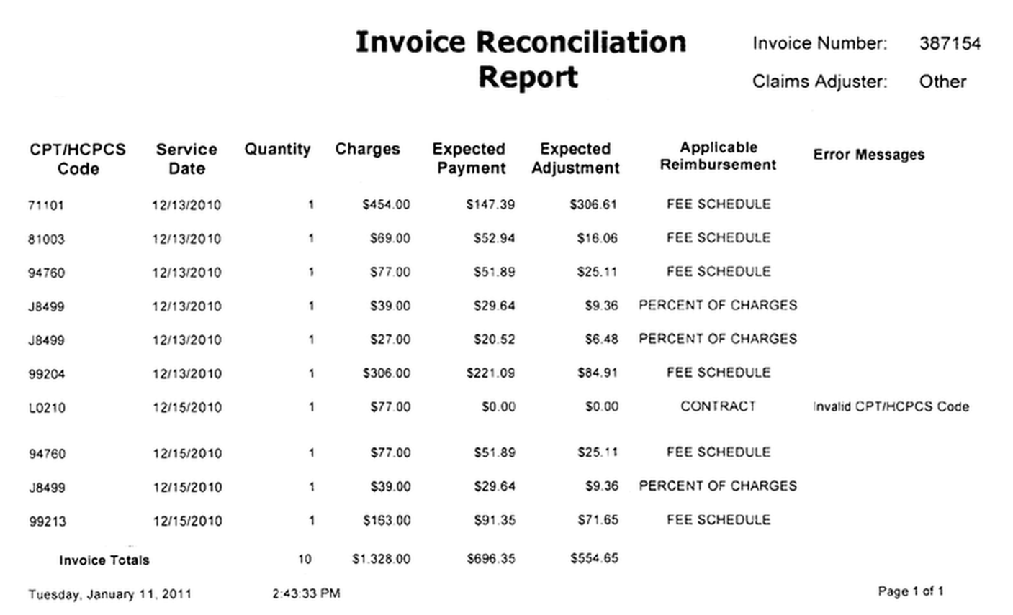
Sample Medical Invoice with Adjustments to State Rates

Sample Medical Invoice with Adjustments to State Rates


Look at this. The first item on the invoice is code 71101, an x-ray of chest and ribs. By negotiating a better rate up front, this trucking company got a service that normally costs $454.00 for a mere $147.39 – a reduction of more than 2/3 in the fee!  On a total invoice that would have cost $1,328.00 at “retail,” the clever trucking company got a whole array of medical services for $554.65 – a savings of more than 57%.  This is a real-life example.  Remember that the savings are compounded: not only are you never paying more than the state rate, but none of this is going on your insurance, adding to your loss ratio, raising your experience mod, raising your renewal premiums, and so on. In exchange for a modest direct payout of wages and medical bills, you have avoided a whole slew of insurance costs.

Using this approach can even save you money retroactively. Contact your state WC office and ask how far back in time your state permits you to recover amounts that you were overbilled by providers. The burden is still on you to ask the provider to refund the difference, but every dollar you recover like this is money in your pocket.

Have you tried this in your own company? Have questions?  Want to comment?  Please do. Leave them in the “comment” section, and we’ll reply.

Disclaimer: The content of LocalTruckingBlog.com is intended for general information purposes only, and is not legal advice.  State law varies, and you should consult with an attorney on these matters.

Read More

Welcome! — to the online community for local trucking

Posted by | Posted in News and Links | Posted on 04-03-2011

Welcome to The Local Trucking Blog. This blog is the hub of an online community that speaks to the interests of local trucking companies, their owners and managers, and the wider community that they serve.

Depending on your part of the country, local trucking can have different names. We publish content that is designed to meet the needs of:

  • local trucking companies;
  • local cartage firms;
  • local companies with in-house trucks;
  • and local pickup and delivery (P&D) companies.

We invite you to check back frequently. Our posts cover a wide range of topics, including:

  • management issues:  legal, tax/accounting, delegating succession planning, and more
  • insurance issues:  liability, worker’s comp, and more
  • software and hardware:  what to look for in a TMS, in power units and trucks, in smartphones, and more
  • legislative matters:  HOS, EOBR, and more

If you’re an owner, GM, or manager in local trucking, we want to be the one-stop online resource for your concerns.  Click “subscribe” to join our community and receive notification of new postings.  Please check back often, feel free to post comments, and be sure to tell us if we’re covering what matters to you most (and if we’re not).

Thanks, and welcome!

–Jonathan Miller, Editor


Read More