Appeals Court Vacates EOBR Regulation

Posted by | Posted in Equipment Issues, Industry Trends, Legislative Issues, News and Links, Personnel and HR Issues | Posted on 29-08-2011

Because the proposed EOBR regulation did not address how the rule could prevent EOBR devices from being used to harrass drivers, a federal appeals court in the Seventh Circuit (in Chicago) vacated the regulation on August 26th.

Click here to see the article in CCJ.

As we’ve posted before, the EOBR rule generally would not have applied in local trucking because of the 100- or 150-mile HOS exemption.  Despite this setback for the FMCSA, the EOBR issue is not dead.  Watch this space for further news.

–The Editors

Read More

California Supreme Court Decision in Trucking Company Employer-Liability Case

Posted by | Posted in Legal / Lawyers / Attorneys, News and Links | Posted on 03-08-2011

We thought this was worth your consideration:

California Supreme Court Decision

Check it out.

–The Editors


Read More

HHUT: When To File, When To Pay in Local Trucking?

Posted by | Posted in Costs and Cash Flow in Local Trucking, Legislative Issues, News and Links | Posted on 01-08-2011

The Internal Revenue Service today advised truckers and other owners of heavy highway vehicles that their next federal highway use tax return, usually due Aug. 31, will instead be due on Nov. 30, 2011.

Because the highway use tax is currently scheduled to expire on Sept. 30, 2011, this extension is designed to alleviate any confusion and possible multiple filings that could result if Congress reinstates or modifies the tax after that date. Under temporary and proposed regulations filed today in the Federal Register, the Nov. 30 filing deadline for Form 2290, Heavy Highway Vehicle Use Tax Return, for the tax period that begins on July 1, 2011, applies to vehicles used during July, as well as those first used during August or September. Returns should not be filed and payments should not be made prior to Nov. 1.

To aid truckers applying for state vehicle registration on or before Nov. 30, the new regulations require states to accept as proof of payment the stamped Schedule 1 of the Form 2290 issued by the IRS for the prior tax year, ending on June 30, 2011. Under federal law, state governments are required to receive proof of payment of the federal highway use tax as a condition of vehicle registration. Normally, after a taxpayer files the return and pays the tax, the Schedule 1 is stamped by the IRS and returned to filers for this purpose. A state normally may accept a prior year’s stamped Schedule 1 as a substitute proof of payment only through Sept. 30.

For those acquiring and registering a new or used vehicle during the July-to-November period, the new regulations require a state to register the vehicle, without proof that the highway use tax was paid, if the person registering the vehicle presents a copy of the bill of sale or similar document showing that the owner purchased the vehicle within the previous 150 days.

In general, the highway use tax applies to trucks, truck tractors and buses with a gross taxable weight of 55,000 pounds or more. Ordinarily, vans, pick-ups and panel trucks are not taxable because they fall below the 55,000-pound threshold.

For trucks and other taxable vehicles in use during July, the Form 2290 and payment are, under normal circumstances, due on Aug. 31. The tax of up to $550 per vehicle is based on weight, and a variety of special rules apply to vehicles with minimal road use, logging or agricultural vehicles, vehicles transferred during the year and those first used on the road after July.

Read More

Texting (or Not) While Driving — the Local Trucking Angle

Posted by | Posted in Industry Trends, Legal / Lawyers / Attorneys, Legislative Issues, News and Links | Posted on 28-07-2011

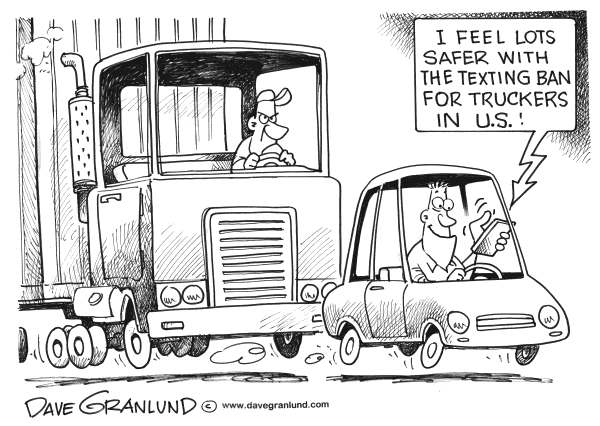
As of this writing, 34 states, the District of Columbia, and Guam have adopted laws prohibiting texting while driving. These laws cover all drivers, not just truck drivers.

Click here to see a table of all current state texting laws.

Illinois, Texas, and Arkansas also ban any use of cell phones in school and construction zones.

safe local trucking driving

Don't Text and Drive Your Truck!

Also, for just over a calendar quarter now, no truck driver in the nation may text while transporting hazmat.  Click here to read more.

What is your experience with local trucking and the new texting laws?

–The Editors

Read More

Are You Missing a Truck?

Posted by | Posted in Equipment Issues, News and Links | Posted on 30-06-2011

As reported in the Chicago Tribune:

An asteroid with the estimated girth of a 26-foot box truck sailed within 7,500 miles of Earth on Monday, June 27th as it passed harmlessly over the Atlantic Ocean, according to NASA’s Jet Propulsion Laboratory.

The space rock followed the path that scientists had predicted, looping around the planet in a boomerang-shaped trajectory, NASA spokesman D.C. Agle said.  Its nearest approach to Earth was 30 times farther away than the International Space Station.

We were wondering how this could have happened.

  • Did the driver’s GPS give him a faulty pickup location?
  • Was he on a clandestine rendezvous with a highly exotic girlfriend?
  • Was the truck propelled into space by a hyperactive lift gate?

If this is your truck, please let us know.  We can contact NASA on your behalf.

–The Editors

Read More

Indemnification Clause in Local Trucking Contracts

Posted by | Posted in Industry Trends, Legal / Lawyers / Attorneys, News and Links | Posted on 20-06-2011

Many local trucking companies have been confronted with contracts containing an Indemnity clause.  It typically states:

“CARRIER shall at all times indemnify, defend and hold harmless BROKER, its parent, subsidiaries and affiliates, and their respective directors, officers agents and employees against and from any and all claims arising from the services provided hereunder (including, without limitation, claims for personal injury, death and damage to property, clean‑up costs from commodity spills and damage to the environment, whether or not caused by (a) by any agent or employee of CARRIER or (b) by any other person or entity.  The provisions of this Paragraph shall survive cancellation, termination, or expiration of this Agreement.”

This means that even if an accident is caused by the broker’s negligence, or shipper’s negligence, or by any reason whatsoever, the carrier is responsible to pay legal fees, claims, and judgments against the broker. Of course, this is very unfair.  The problem has been that carriers are rarely given a choice.  The attitude is typically, “sign this or forget about getting work,” and, because of business pressures, many sign.  Some insurance policies would not pay such a claim, so the carrier is risking its very existence by signing such a document.

Well, help is at hand in most of the USA.  During the past two years, most states have passed, or are considering passing, an “anti-indemnification” law.  The law invalidates any clause that forces the carrier to indemnify the broker.  If you live in a state that has passed “anti-indemnity” laws, you can safely sign contracts that contain the clause and know it cannot be enforced.

WARNING! If the contract states that it shall “be construed under the laws of …….”, with a different state filled in, make sure THAT state is one that has passed an “anti-indemnity” statute or you WILL NOT be protected.

To see a map of states which have passed “anti-indemnity” statutes, click here.


Read More

Hiring Qualified Local Truck Drivers

Posted by | Posted in Personnel and HR Issues | Posted on 14-06-2011

We here at the Local Trucking Blog have been hearing about increasing difficulty hiring qualified, experienced local CDL drivers.  Everyone agrees the CSA initiative (click here to see more) helps in weeding out unsafe candidates, but that is only part of the equation.  Certain skills are much more important to a local operation.

It is no big deal if a truck takes 15 minutes to spot a trailer after traveling five days cross country.  It is a very different story when you expect productivity of 20 stops a day.  This is why your test drive should include plenty of backing and spotting exercises.

Do you carry hazardous materials? Don’t count on the Hazmat license endorsement to tell you anything about what the candidate knows.  You should have a written test.

Same for other important skills, such as routing and emergency procedures.  A few math questions will help determine if they can accurately count a multi-pallet shipment.

Liftgates? Make them take a skid up and down.

E–track or logistics in your trucks?  Make them secure some freight.

Expect at least 50%, and possibly 80% of your driver candidates to flunk the test.  This is good.  It is always worth waiting for the best driver to hire instead of panicking and taking the best available candidate on hand at the moment.  Your company will be rewarded with lower turnover, lower claims, and higher productivity.

Read More

HOS Rule Release Delayed Until October 2011

Posted by | Posted in Industry Trends, Legislative Issues | Posted on 31-05-2011

The FMCSA has decided to delay, until October, the release of its new Hours of Service (HOS) rules, according to an article published today in The Journal of Commerce.

Click here to read the full article.

The new ruling is not likely to be beneficial to trucking companies, even local trucking firms.  As we’ve noted before, we do not believe the new proposed regulations to be of any benefit. Rather, they will harm local trucking companies.  The newest federal safety data show that the reduction to eleven-hour days was sufficient to dramatically reduce accidents and injuries.  Any further reduction is unnecessary and will be harmful to the industry and to the drivers who work for local trucking and cartage firms.

If you have concerns about how the pending HOS rules affect your local trucking business, don’t just sit on your hands;  contact your elected representatives!

–The Editors

Read More

Keeping Your Docks Safe in Local Trucking

Posted by | Posted in Equipment Issues, News and Links | Posted on 10-05-2011

We came across an interesting approach for keeping trucks connected to docks and preventing injuries.

Click here to read the complete article.

While it’s written by a biased source (the author works for a company that makes RIG-based and wheel restraints), the issues are worth exploring, and you can’t argue with improving safety and reducing injuries.

Who out there has experience with restraints of these types?


Read More

A Mileage Tax On Local Trucking?

Posted by | Posted in Industry Trends, Legislative Issues, News and Links | Posted on 06-05-2011

A proposal is being floated in Washington that would tax mileage on all vehicles–including local trucks, OTR trucks, even cars.

http://www.truckinsurancepro.com/industry-news/proposal-to-tax-mileage/

Take a look, read all about it, and contact your legislators if you are so moved.

Keep rolling,

Jonathan Miller, Editor


Read More