
Cutting Costs in Local Trucking

There was an interesting question posed by Deborah Lockridge, editor at Heavy Duty Trucking, early this week, which sparked a discussion thread:

http://www.linkedin.com/groups/What-tips-do-you-have-134135.S.107106598?qid=44123cd7-93fa-474f-9c4e-55590cc41bbd&trk=group_most_popular-0-b-ttl&goback=.gmp_134135

While some people commented on fuel efficiency, reducing accidents caused by sloppy backing up, and so on, we feel strongly that having the right TMS is the #1 way to cut costs in local P&D, by reducing bottlenecks and redundancies in the office environment and by making drivers more productive.

If your staff never had to put people on hold to answer a POD request, how much time would that alone save you, not to mention how much your customers would appreciate it?

As one person commented in the replies:  “The wrong software is wrong, even if free, and the right TMS is golden, no matter the cost. The money spent is insignificant compared to the personnel savings and increased productivity of the drivers.”

The Editors

Read More

Your Local Truck Drivers: Independents or Employees?

Posted by | Posted in Industry Trends, News and Links, Personnel and HR Issues | Posted on 17-11-2011

The IRS is announcing a “voluntary reclassification” program that would provide partial protection for businesses that agree to prospectively treat workers, who had been formerly treated as contractors, as employees.

Click here to read the full article.

Food for thought!

–The Editors

Read More

GPS Options for Local Trucking Fleets

Posted by | Posted in Equipment Issues, Industry Trends, News and Links, Technology for Local Trucking | Posted on 11-11-2011

We found this article on TruckingInfo.com that discusses the possible options and benefits of deploying GPS in a smaller fleet:

Click here to see the full article.

Depending on what works best with your TMS, there are a variety of GPS packages that can give you the functionality you need.  In addition to watching GPS “breadcrumbs” on a screen, dispatchers can benefit from systems such as Actsoft’s Comet Tracker, which has simple drop-down forms for drivers to enter arrival and departure times; this can be used as an alternative to geofencing.

Keep in mind that EOBR rules that usually apply for OTR fleets are waived for local trucking because of the 100-mile exemption.

–The Editors


Read More

Top 5 Reasons Not To Hire A Local Truck Driver: Best Practices

Posted by | Posted in Equipment Issues, Industry Trends, News and Links, Personnel and HR Issues | Posted on 09-11-2011

Everyone is complaining about the driver shortage. But don’t make the mistake of hiring unqualified drivers.  As we have said previously, it is always worth waiting for the best driver to hire instead of panicking and taking the best available candidate on hand at the moment.  Your company will be rewarded with lower turnover, lower claims, and higher productivity.

In local pickup and delivery work, what are the top 5 reasons you would not want to hire a driver?  Here’s our list of best practices:

  • Reason #5:  Securing freight. If a driver can’t use e-track or logistic straps, that driver shouldn’t work for you.
  • Reason #4:   Liftgates.  Your drivers need to show you — not just tell you — that they can take a skid up and down.  Make every candidate do this in front of you.
  • Reason #3:  Math.  Every driver must be able to count the number of pallets in a shipment, with no mistakes.
  • Reason #2:  Hazmat. Don’t just look at the endorsement!  Make the driver take a written test.
  • And the Top, #1, Most Important Thing in local P&D that a driver needs to do to make you money:  Backing and Spotting.  Make the driver show you his/her speed and accuracy.  When you’re making 20 stops a day, you can’t afford drivers who are slow at this.

Do the right thing.  Be patient, and be tough.  If you flunk between half  and 3/4 of your applicants, you have a good test.

–The Editors

Read More

What’s Luck Got To Do With It? Success in Local Trucking

Posted by | Posted in Industry Trends, News and Links, Technology for Local Trucking | Posted on 03-11-2011

We just found a great article in the New York Times, on the role that luck plays in some business being 10x more successful in their sectors than others.  Everyone has luck, but the issue is this:  what sort of return on luck do you have?

Click here to read the article.

Moving Forward,

Jonathan Miller, Editor


Read More

Recruiting Drivers for Local Trucking: The Medium is the Message

Posted by | Posted in Industry Trends, Personnel and HR Issues | Posted on 25-10-2011

Have you hit a wall in your usual recruitment efforts for new drivers?

Maybe you’re stuck in yesterday’s ways of communicating about your vacancies.

We thought this approach outlined in Transport Topics was interesting.

Click here to read the full article.

Simply put, you have to reach people where they are looking. The perspective given here also applies broadly in other business sectors and includes purchasing habits. For example, Generation Y people (people aged roughly 18-34 in 2011) rarely if ever read things that aren’t online. The take-away is that, if you’re only advertising in print publications for your driver positions, you will essentially be invisible to that age group.

–Jonathan Miller, Editor


Read More

Appeals Court Vacates EOBR Regulation

Posted by | Posted in Equipment Issues, Industry Trends, Legislative Issues, News and Links, Personnel and HR Issues | Posted on 29-08-2011

Because the proposed EOBR regulation did not address how the rule could prevent EOBR devices from being used to harrass drivers, a federal appeals court in the Seventh Circuit (in Chicago) vacated the regulation on August 26th.

Click here to see the article in CCJ.

As we’ve posted before, the EOBR rule generally would not have applied in local trucking because of the 100- or 150-mile HOS exemption.  Despite this setback for the FMCSA, the EOBR issue is not dead.  Watch this space for further news.

–The Editors

Read More

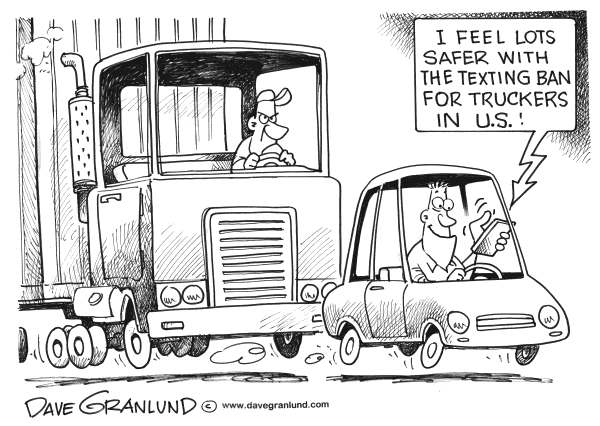
Texting (or Not) While Driving — the Local Trucking Angle

Posted by | Posted in Industry Trends, Legal / Lawyers / Attorneys, Legislative Issues, News and Links | Posted on 28-07-2011

As of this writing, 34 states, the District of Columbia, and Guam have adopted laws prohibiting texting while driving. These laws cover all drivers, not just truck drivers.

Click here to see a table of all current state texting laws.

Illinois, Texas, and Arkansas also ban any use of cell phones in school and construction zones.

safe local trucking driving

Don't Text and Drive Your Truck!

Also, for just over a calendar quarter now, no truck driver in the nation may text while transporting hazmat.  Click here to read more.

What is your experience with local trucking and the new texting laws?

–The Editors

Read More

Indemnification Clause in Local Trucking Contracts

Posted by | Posted in Industry Trends, Legal / Lawyers / Attorneys, News and Links | Posted on 20-06-2011

Many local trucking companies have been confronted with contracts containing an Indemnity clause.  It typically states:

“CARRIER shall at all times indemnify, defend and hold harmless BROKER, its parent, subsidiaries and affiliates, and their respective directors, officers agents and employees against and from any and all claims arising from the services provided hereunder (including, without limitation, claims for personal injury, death and damage to property, clean‑up costs from commodity spills and damage to the environment, whether or not caused by (a) by any agent or employee of CARRIER or (b) by any other person or entity.  The provisions of this Paragraph shall survive cancellation, termination, or expiration of this Agreement.”

This means that even if an accident is caused by the broker’s negligence, or shipper’s negligence, or by any reason whatsoever, the carrier is responsible to pay legal fees, claims, and judgments against the broker. Of course, this is very unfair.  The problem has been that carriers are rarely given a choice.  The attitude is typically, “sign this or forget about getting work,” and, because of business pressures, many sign.  Some insurance policies would not pay such a claim, so the carrier is risking its very existence by signing such a document.

Well, help is at hand in most of the USA.  During the past two years, most states have passed, or are considering passing, an “anti-indemnification” law.  The law invalidates any clause that forces the carrier to indemnify the broker.  If you live in a state that has passed “anti-indemnity” laws, you can safely sign contracts that contain the clause and know it cannot be enforced.

WARNING! If the contract states that it shall “be construed under the laws of …….”, with a different state filled in, make sure THAT state is one that has passed an “anti-indemnity” statute or you WILL NOT be protected.

To see a map of states which have passed “anti-indemnity” statutes, click here.


Read More

HOS Rule Release Delayed Until October 2011

Posted by | Posted in Industry Trends, Legislative Issues | Posted on 31-05-2011

The FMCSA has decided to delay, until October, the release of its new Hours of Service (HOS) rules, according to an article published today in The Journal of Commerce.

Click here to read the full article.

The new ruling is not likely to be beneficial to trucking companies, even local trucking firms.  As we’ve noted before, we do not believe the new proposed regulations to be of any benefit. Rather, they will harm local trucking companies.  The newest federal safety data show that the reduction to eleven-hour days was sufficient to dramatically reduce accidents and injuries.  Any further reduction is unnecessary and will be harmful to the industry and to the drivers who work for local trucking and cartage firms.

If you have concerns about how the pending HOS rules affect your local trucking business, don’t just sit on your hands;  contact your elected representatives!

–The Editors

Read More